Why this is worth ten minutes
Almost every crypto signal service publishes a win rate. Almost none of them publishes the definition that produced it, and the definition is where the entire figure is decided. That is not usually fraud. It is that a number with no method attached will drift towards whichever reading flatters the person who computed it, and nobody is checking.
So the checks below are not about spotting liars. They are about telling an auditable record from an unauditable one, which is a question with an answer.
A win rate is a fraction. Ask what is underneath it
Every published win rate is wins divided by something, and the something is where almost all of the dishonesty lives. Two services posting the identical set of trades can publish very different win rates without either of them typing a false number, purely by disagreeing about which calls belong in the denominator.
The usual exclusions are cancelled setups, calls that never filled, calls that were corrected after posting, positions closed at breakeven, and anything posted as “educational” rather than as a call. Each has a reasonable-sounding justification. Together they can remove most of the losses from a record without a single deleted message.
What to askHow many calls were posted in this window, and how many are in the record? If those two numbers differ, what happened to the difference — and where can I read the ones that were removed?
Every eligible call closed in the window is in the ledger, wins and losses in one table. Stop-outs score −1R with no exception. Cancellations and expiries are counted and shown separately rather than dropped, so they cannot quietly lift a win rate, and a correction is recorded against the original signal instead of replacing it.
Breakevens sit outside the win-rate denominator and the page says so, because a rule you have to infer from the arithmetic is not a published rule.
“Win” is a definition, not a fact
A call with five targets that reaches the first and then stops out at entry: win or loss? Both answers are defensible and they produce wildly different records. The same question applies to partial exits — whether taking 30% off at the first target scores the same as closing the whole position there.
This is the single most effective place to inflate a record without lying, because the definition is rarely printed next to the figure it produced. If a service reports “TP1 hit” as a win and never tells you what happened to the rest of the position, the win rate is measuring how often price moved a little in the right direction.
What to askIs a partially-filled or partially-closed trade a win, and at what point? Show me a call that hit its first target and then reversed, and tell me how it was scored.
Results are scored on the full position against the stop that was posted before entry, and the treatment of partials, of laddered entries that only fill in part, and of open positions at the window boundary is written into the methodology rather than left to be inferred.
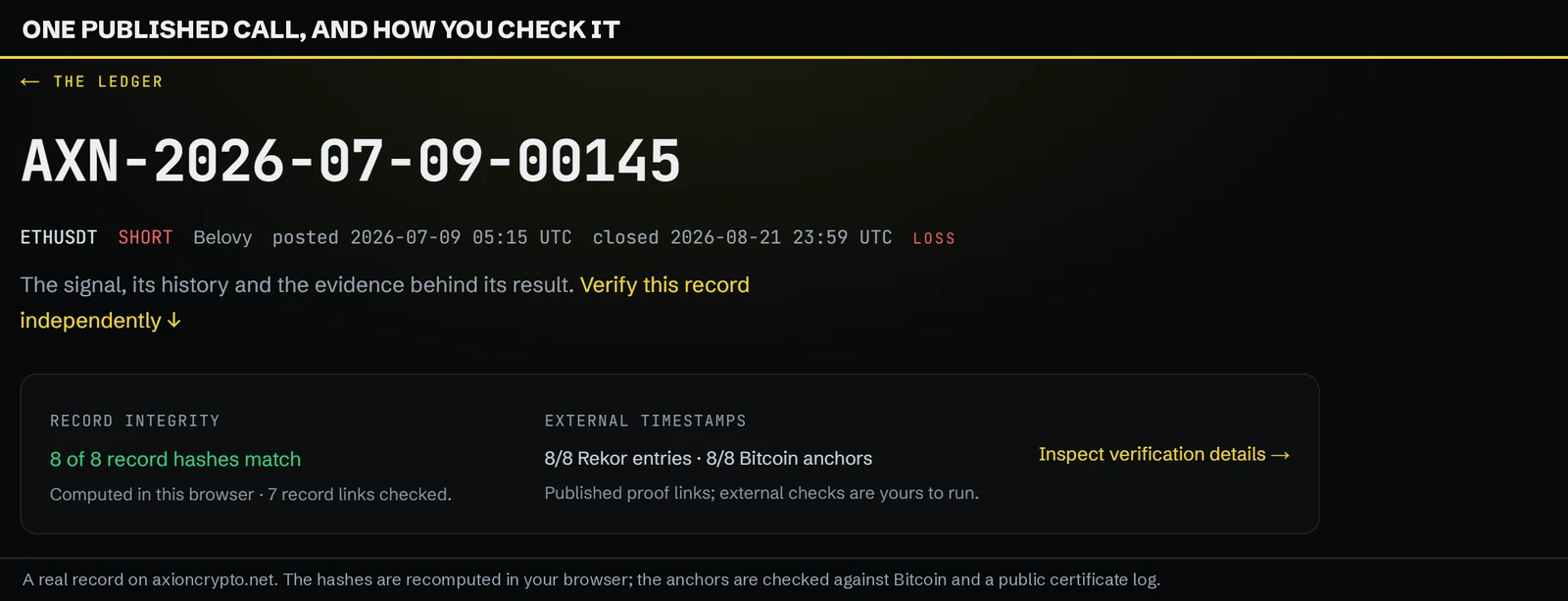
Each closed call has its own page carrying the levels as posted, everything that happened afterwards in order, and the arithmetic that turned it into a result — so the scoring rule can be checked against a trade rather than read as a policy.
Percentages are not comparable. R is, if the stop is honest
“+340% this month” is not a result, it is a result multiplied by a position size and a leverage setting you were not told. The same trades at 3× and at 30× produce different headlines and identical skill. Any figure quoted as an account return is describing somebody's sizing decisions, not their analysis.
R multiple fixes that, because it measures the move against the distance to the stop: risk one unit, make two, that is +2R whatever you sized it at. But R is only meaningful if the stop it is measured against is the stop that was published before the trade was entered. An R computed against a stop moved later is a percentage wearing a lab coat.
What to askIs this R measured against the stop as posted, before entry? Where is that original stop recorded, and can I see it was not edited afterwards?
Every figure is reported in R multiple and in raw price move. There is no account return anywhere on the site and no leveraged figure derived from R, because neither would be ours to publish — your return depends on sizing we do not control.
R is measured against the posted stop. The per-trade pages show the levels as they were originally posted alongside any later revision, flagged rather than filtered, so a moved stop is visible instead of absorbed.
A screenshot has no time on it
The claim under every track record is that the call was made before the move, and a cropped image cannot carry that claim — it can be taken at any point afterwards, and edited before it is taken. A spreadsheet assembled at the end of the month has the same problem in a tidier font.
What settles it is evidence that existed at the time and cannot be quietly rewritten since. A message id in a chat platform carries its own creation time and an edit history. Stronger still is a hash of the record published somewhere the publisher does not control — a public append-only log, or a blockchain — because then the question stops being whether you trust them and becomes arithmetic you can do yourself.
What to askWhat proves this call existed before the outcome, other than your own copy of it? If the record were altered tomorrow, what would break?
Each call's record is hashed when it is written, and the hash is published in three places, one of them the Bitcoin blockchain. The per-trade page recomputes that hash in your browser from the record it is showing you and hands you the links to check the anchors yourself — so the page cannot show you one thing and have hashed another.
The original message is referenced by id with a jump link rather than reproduced, and the revision history lists superseded events flagged instead of removed.
Anybody can show you their best trade
The evidence a service volunteers is a selection somebody made for you, and a selection is not a sample. The only version of this that means anything is the one where you choose which trade to inspect — ideally a losing one, ideally on a date you name.
This is also the fastest test to run. It takes one message, and the response tells you almost everything: a full record makes it trivial, a curated one makes it awkward, and the awkwardness is the finding.
What to askShow me every call from the worst week you had this quarter — not your best trade, the week you would rather I did not look at.
The ledger filters and downloads as a CSV, so you can sort by the worst results and read those. Every row opens the full record for that call.
The captures on this site are published unedited and unredacted, entries, stops, targets and outcomes as posted — including, on the how-it-works page, a laddered entry that never filled and is reported as missed rather than dropped.
The headline figure should be derivable from the record underneath it
A summary and a ledger are two different claims, and they are not automatically consistent. If the rows are downloadable, the win rate and the cumulative result at the top of the page are arithmetic you can do in a spreadsheet in about five minutes.
If they disagree, the summary is marketing. If the rows cannot be downloaded at all, there is nothing to check and the figure is an assertion — which is where most published track records quietly are.
What to askCan I download the underlying rows? If I add them up, will I get the number at the top of your page?
The published figures are served as data as well as drawn on the page, so the comparison does not depend on how a page happens to be laid out.
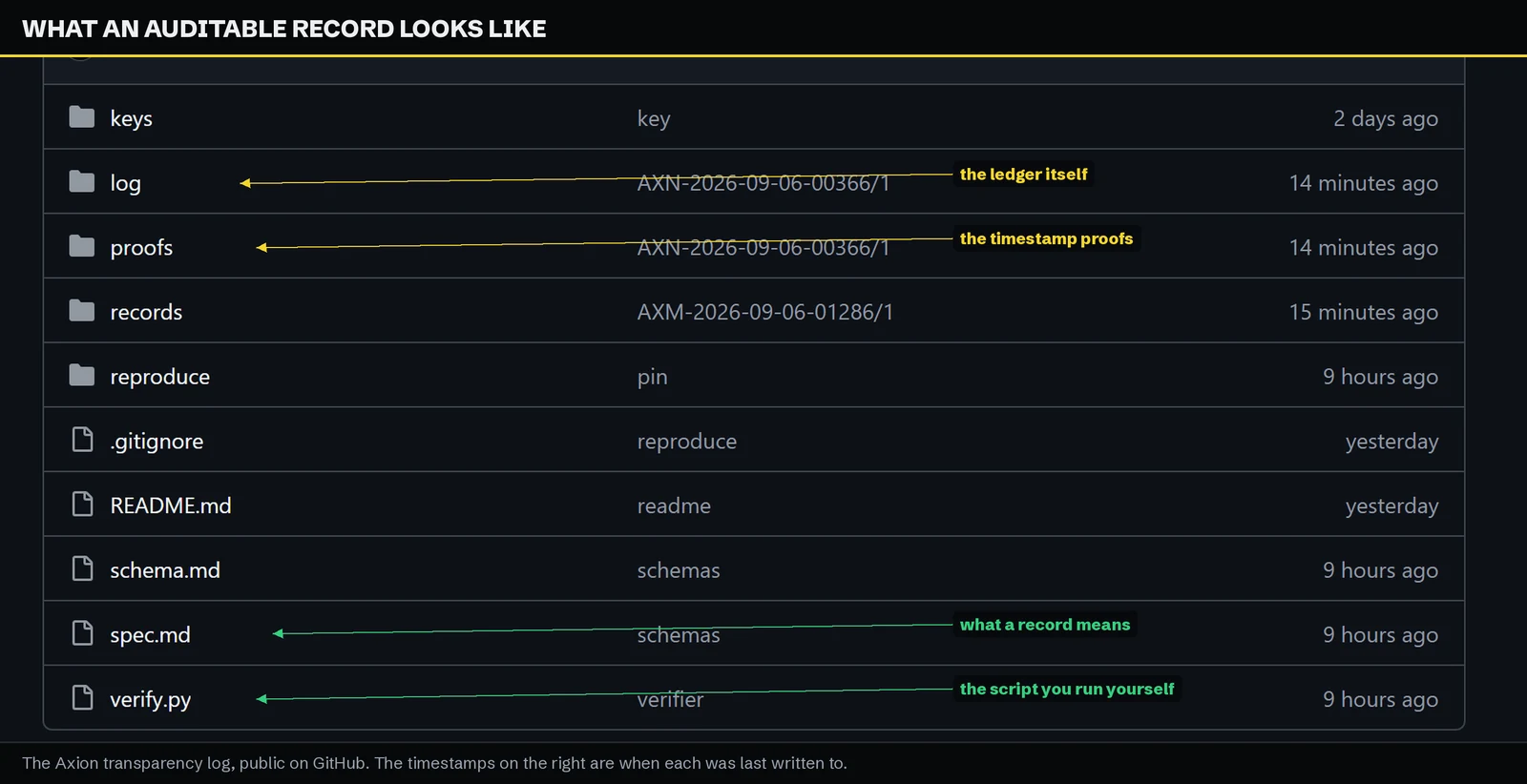
The public repository holds a reproduce directory: a script that downloads the same ledger CSV anybody can download, recomputes every figure on the performance page from it, and prints its own answers beside the published ones so the two can be read line by line. There is also a verifier for a single call, and a written specification of how each record is built and hashed.
The published result is not what a follower gets
A signal's result is measured on the signal. Yours is measured on your fill. Between them sit exchange fees on both legs, slippage — worse on a stop than on an entry — funding if you held through it, and the minutes between the call being posted and you reading it.
None of that makes a published figure dishonest. Presenting it as what you would have made does. The useful question is whether the service has done the subtraction anywhere, or whether it is leaving you to discover it with money.
What to askWhat does this record look like after fees and slippage? If you have not modelled it, say so — but then do not describe the gross figure as my return.
R is gross of fees, funding and slippage, and the page says so rather than leaving you to find out. Beside it, a modelled follower figure applies one round trip of fees and slippage per call, with the assumptions — the rate per leg, and the fact that funding and execution delay are not applied — published from what the upstream system reports rather than typed in beside it.
It is labelled as modelled and kept out of the measured tiles, because presenting a model as a measurement is the same error in a friendlier direction. A follower who held through a funding window, or who was slower than the analyst, paid more than the modelled figure.
What verification cannot tell you
Everything above establishes that a record is complete and that it has not been edited after the fact. That is worth a great deal and it is the part almost nobody publishes. It is also strictly a claim about the past.
A verified record does not mean the next quarter resembles the last one. It does not mean the person following the calls makes money, because sizing, timing and the decision to skip the uncomfortable trade are all theirs. And it says nothing about whether a market that has been kind to a particular style keeps being kind to it.
Anyone who answers every check above and then tells you what you will make has failed the more important test. We are not going to do that, and neither should they.
Now run it on us
The whole point of writing the checks down is that they are answerable by anybody, and that includes the people who wrote them. Every answer above is a link rather than a claim, so start with the ledger and try to break one.
Then take the list somewhere else. None of these questions required an opinion about anyone.
Education, not advice. Nothing here is a recommendation to buy or sell anything, and every example is one trade rather than a rule.