About the list you probably just read
Search for the best crypto trading Discord and most of the first page is affiliate content. The ranking is by commission rather than by quality, the reviews are written from the marketing pages, and the order changes when the payouts do. This is not a conspiracy theory, it is a disclosed business model — the disclosure is usually in the footer.
We are not going to answer that with another ranking, because we sell one of the things being ranked and a self-ranking is worth exactly nothing to you. What follows is the structure underneath the category instead.
Read the money, not the pitch
Every one of these rooms has to earn somehow, and how it earns predicts what it does far better than what it says about itself. A room paid on your trading volume behaves differently from one paid on your subscription, which behaves differently again from one paid on a challenge fee.
So the useful first question is not “is this one good”. It is “how does this one get paid, and what does that make it want”.
The free room funded by exchange referrals
Nothing from you directly. The operator earns a share of the trading fees you generate after signing up to an exchange through their link, for as long as that account keeps trading. The exact share is published in the exchange's own affiliate terms.
Volume. The revenue is a fraction of fees paid, and fees are paid on turnover regardless of whether the turnover made you anything — so more calls, more often, at higher leverage, all pay better. Nothing about the model rewards telling you to sit out a week.
Joining requires an exchange link, or a UID, or a deposit before the good channels open. Ask how the room is funded. If the answer is a referral, you now know what the call frequency is optimising for.
In fairness. A referral is not in itself dishonest, and plenty of free rooms are run by people who trade the calls themselves. It is the one model where you should discount the call frequency rather than the calls.
The paid signal feed
A subscription. That is the whole model.
Renewal, which means it needs you to keep needing it. There is no structural reason for a pure signal feed to explain its reasoning, because a member who understands the reasoning is a member who eventually stops paying.
Calls arrive as levels with no argument attached, and the education, if any, is generic material unconnected to the trades. Ask what a member knows after a year that they did not know when they joined. A feed that cannot answer that is renting you an opinion.
In fairness. For an experienced trader who wants idea flow and does their own filtering, this is a perfectly reasonable thing to buy. It is a bad first purchase for someone who cannot yet tell a good call from a bad one, because the product assumes you can.
The education-first community
A subscription, the same as above.
The same renewal pressure, with one difference that matters: the stated goal is your independence, which is in open tension with the business model. Worth naming rather than glossing, because a community claiming this and quietly optimising for dependence looks identical from outside on day one.
The calls carry their reasoning, and the teaching material is built from the trades rather than bought in as a generic course. The harder test is whether the record includes the losing trades and explains them, because a loss explained is the most useful teaching material a community has and the most tempting thing to leave out.
The funded-account funnel
The challenge fee. The community is a lead magnet for a prop-firm evaluation, and the evaluation is priced on the assumption that most attempts fail.
Attempts. Every retry is revenue, so the incentive runs towards confidence rather than caution, and towards strategies that either pass fast or fail fast.
The free content is unusually good and it all ends at the same call to action. Ask what share of accounts pass, what share of passed accounts ever get paid, and what the largest payout actually was. The numbers exist; whether they are published is the finding.
In fairness. Funded programmes are a real product and some traders genuinely use them. The community attached to one is still marketing, and should be read as such.
The coordinated buy
Position. The operators and the inner tier are in before the announcement, and the announcement is the exit.
Speed and secrecy. Tiered access sold by how early you are told is the model stated out loud, and everybody below the top tier is exit liquidity.
Low-liquidity tokens, countdown timers, paid tiers that buy you earlier notice, and language about coordination. This one is not a category to evaluate carefully. It is a category to leave.
“Best” depends on which of two things you want
There are two legitimate reasons to join one of these, and they point at different products. Either you want to be told what to do, by somebody better at it than you are — or you want to get to the point where you no longer need to be told.
The first is served fine by a signal feed, and buying one is a reasonable decision if you already know how to size a position and when to skip a call. The second needs the reasoning attached to every trade and a record that includes the ones that went wrong, because those are the material you actually learn from.
Most people arrive wanting the first and would be better served by the second. Only you can settle which, but decide it before you pay for anything, because the two products look identical on a sales page.
Where we sit, and where we are wrong for you
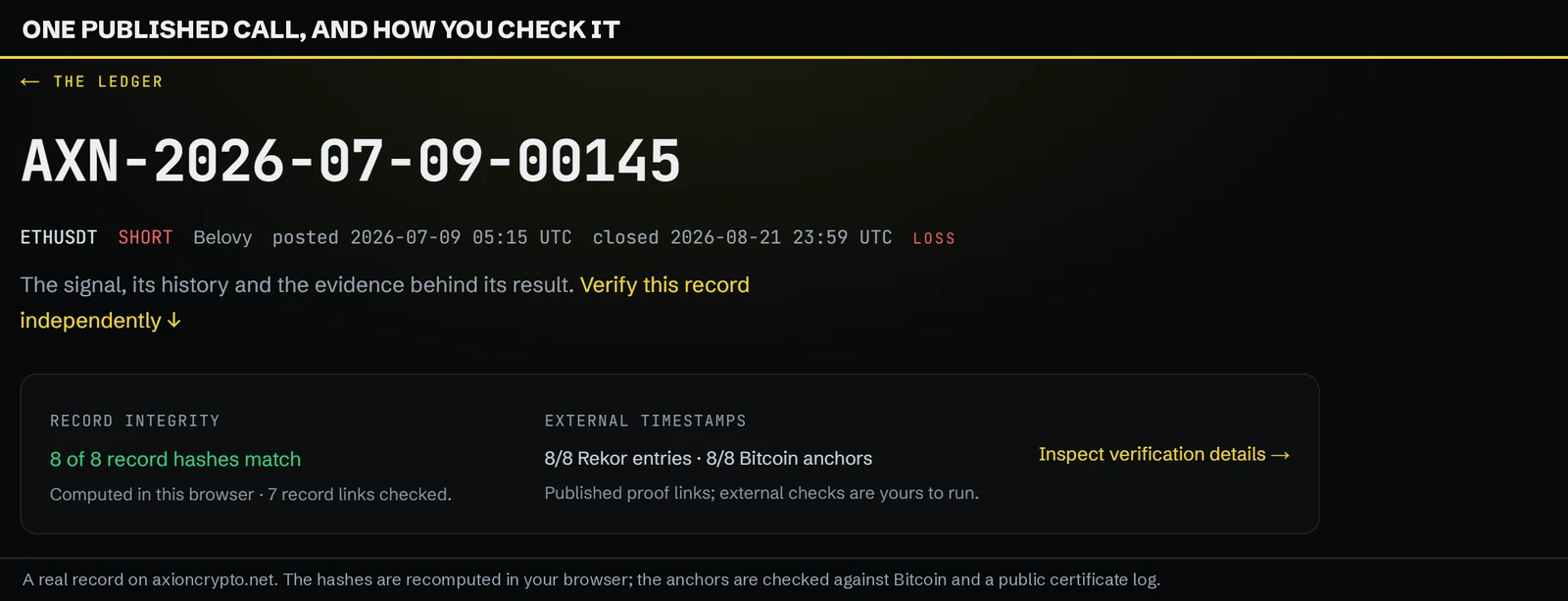
Axion is the third category. It is a paid Discord, the calls carry their reasoning, the education is built from the same trades, and every closed call goes into a public ledger with the losses in it. That is the pitch, and the whole of the rest of this site exists so you can check it rather than believe it.
It is the wrong purchase if you want copy-trading that places orders for you — we do not do that. It is wrong if you want somebody to manage your money, which we are not licensed to do and will not do. It is wrong if you are looking for free, because it is not. And it is wrong if you want certainty about what you will make, which nobody in any of these five categories can honestly sell you.
Once you know which category, run the checks
Knowing how a room earns narrows the field. It does not tell you whether a particular one is any good, and that is a separate exercise with its own questions — the losing trades, the method, the evidence per trade, the price quoted the same inside and outside, and how to tell the real community from somebody impersonating it.
If the thing you most want to test is the track record itself, the seven verification checks go at that specifically.
Education, not advice. Nothing here is a recommendation to buy or sell anything, and every example is one trade rather than a rule.