Why a signal service is the wrong first purchase
A signal tells you what somebody else would do. Acting on it still requires you to size the position, place the stop, decide whether this particular call fits an account you have not yet defined the risk rules for, and hold your nerve when it goes against you first. None of that is in the signal, and all of it is where the money is actually lost.
So a beginner following good calls badly ends up down, concludes the calls were bad, and leaves. That happens constantly and it is not the analyst's fault. The four things below are cheap, mostly free, and they are what turns a call into something you can act on.
Learn where a stop goes, and why it goes there
A trade without a predefined point at which you are wrong is a bet, not a trade. The stop is not a safety feature bolted on afterwards — it is the thing that makes the position measurable, because the distance to it is what every sensible result is expressed in.
The level itself comes from the chart rather than from your tolerance for pain. A stop placed where you stop feeling comfortable will be hit by noise; a stop placed where the reason for the trade stops being true will not, unless the reason has actually failed. That distinction is most of the difference between a beginner and an intermediate.
Fix your risk per trade as a fraction, and compute the size
Decide what percentage of the account a single loss may cost — a small one, and the same one every time — and then let that number and the stop distance determine the position size. Not the other way round. Sizing first and discovering the risk afterwards is how an account dies on a trade that looked ordinary.
This is arithmetic, so do it with a calculator rather than by feel. The free tool below does it and shows the working, and it deliberately puts risk before leverage, because leverage is an output of that sum rather than an input to it.
Trade small, or on paper, until your process is boring
The first hundred trades are for finding out whether you can follow your own rules under pressure, and that is a genuinely different skill from identifying a setup. Almost everybody can spot a level. Far fewer can leave a stop where they put it while price is moving against them.
Size those trades so that being wrong repeatedly costs you the tuition and not the account. If a run of losses would end your ability to keep trading, you are not testing a process, you are hoping.
Understand that leverage changes the variance, not the edge
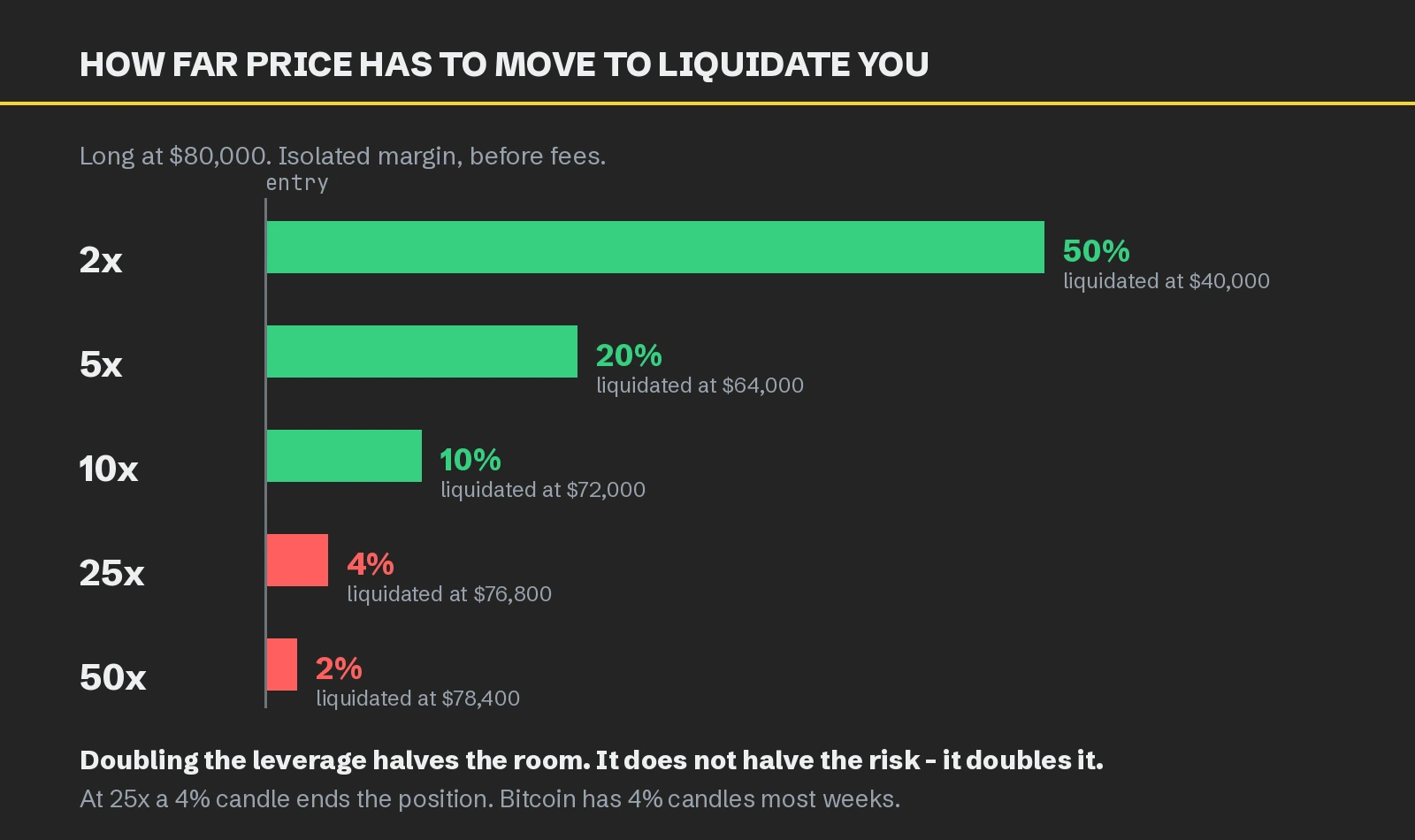
Leverage does not make a trade more likely to work. It multiplies the outcome either way, and it moves your liquidation closer, which means it also increases the chance of being removed from a position that would eventually have been right.
Any presentation of high-leverage returns as evidence of skill is measuring the wrong thing. It is the reason results on this site are published in R multiple and raw price move and never as an account return — the same trades at a different leverage produce a different headline and identical analysis.
The four ways beginners lose money in a signal community
These are not exotic. They are the same four every time, they are all decisions made after the call was posted, and every one of them is avoidable by a rule set in advance.
Sizing up on the one that feels certain
Conviction is not information, and the trade that feels obvious is frequently the crowded one. A fixed fractional risk exists precisely so that your worst judgement of the month cannot cost more than your average one.
Entering late because the move already started
A call has an entry for a reason. Taking it forty minutes and three percent later is a different trade with a worse ratio, and the stop that made sense at the entry now sits far enough away to make the position too large or too fragile. If you missed it, you missed it.
Moving the stop to avoid taking the loss
This converts a small planned loss into an unplanned large one, and it is the single most expensive habit in retail trading. It also destroys your own record: once stops move, none of your results mean anything, because there was no fixed risk to measure them against.
Chasing the loss back
Doubling size after a loss to get back to flat is the same reasoning as doubling a bet after a losing hand. The market has no memory of what you are owed. Where a real edge exists it recovers at its own pace, and speeding that up is only ever done by taking more risk than the edge justifies.
What a community can do
Compress time. You see far more setups discussed in a month than you would find alone in a year, with the reasoning attached, which is the part that transfers.
Give you something to argue with. A call you disagree with and can explain why is worth more to your learning than one you copy, and it is the only way to find out whether your reasoning holds up against someone else's.
Show you the losses. A community that publishes the trades that failed, and why, is handing you the most useful teaching material it has.
What it cannot do
Make you profitable. Nobody can promise that and anybody who does is telling you something they cannot know.
Size your position, hold your stop, or decide when you are tilted and should stop for the day. Those are yours, they are where most of the outcome lives, and no amount of paid access substitutes for them.
Replace screen time. There is no version of this where you skip the part about watching markets and making decisions with a small amount of real money.
Start with the free part
5 of the 61 lessons in the library are open to anybody with no account and no card, and they are the beginner ones — which is the right way round. The position size calculator is free and always will be. The full performance ledger is public, including the losing trades, so you can read the record before deciding whether the rest is worth anything to you.
If you do want to see the paid side, the 3-day trial takes no card and is claimed inside Discord. Do the four steps above first, though. They will make the trial worth more than the trial will make them.
When you do start comparing communities, the ten checks and the verification guide are written so you can run them on anybody, including us.
Education, not advice. Nothing here is a recommendation to buy or sell anything, and every example is one trade rather than a rule.